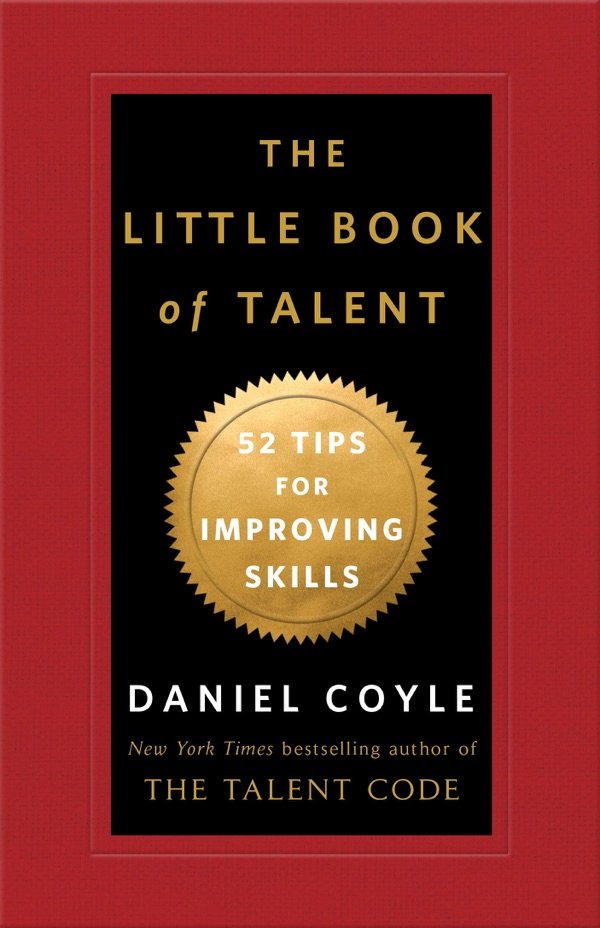
The Little Book of Talent: 52 Tips for Improving Your Skills
von Daniel Coyle
No matter what skill you set out to learn, the pattern is always the same: See the whole thing. Break it down to its simplest elements. Put it back together. When you learn hard skills, be precise and measured. Make one simple move at a time, repeating and perfecting it before you move on. Pay attention to errors, and fix them, particularly at the start. Learning fundamentals only seems boring—in fact, it’s the key moment of investment. If you build the right pathway now, you’ll save yourself a lot of time and trouble down the line.
No matter what skill you set out to learn, the pattern is always the same: See the whole thing. Break it down to its simplest elements. Put it back together.
When you learn hard skills, be precise and measured. Make one simple move at a time, repeating and perfecting it before you move on. Pay attention to errors, and fix them, particularly at the start. Learning fundamentals only seems boring—in fact, it’s the key moment of investment. If you build the right pathway now, you’ll save yourself a lot of time and trouble down the line.
The key to deep practice is to reach. This means to stretch yourself slightly beyond your current ability, spending time in the zone of difficulty called the sweet spot. It means embracing the power of repetition, so the action becomes fast and automatic. It means creating a practice space that enables you to reach and repeat, stay engaged, and improve your skills over time.
The reason, in each case, is the same. Closing your eyes is a swift way to nudge you to the edges of your ability, to get you into your sweet spot. It sweeps away distraction and engages your other senses to provide new feedback. It helps you engrave the blueprint of a task on your brain by making even a familiar skill seem strange and fresh.
All good teaching follows the same blueprint: Try this concrete thing. Now try this concrete thing. Now try combining them into this concrete thing. Communicate with precise nouns and numbers—things you can see and touch and measure—and avoid adjectives and adverbs, which don’t tell you precisely what to do.
"No matter what skill you set out to learn, the pattern is always the same: See the whole thing. Break it down to its simplest elements. Put it back together."
"When you learn hard skills, be precise and measured. Make one simple move at a time, repeating and perfecting it before you move on. Pay attention to errors, and fix them, particularly at the start. Learning fundamentals only seems boring—in fact, it’s the key moment of investment. If you build the right pathway now, you’ll save yourself a lot of time and trouble down the line."
"The key to deep practice is to reach. This means to stretch yourself slightly beyond your current ability, spending time in the zone of difficulty called the sweet spot. It means embracing the power of repetition, so the action becomes fast and automatic. It means creating a practice space that enables you to reach and repeat, stay engaged, and improve your skills over time."
"The reason, in each case, is the same. Closing your eyes is a swift way to nudge you to the edges of your ability, to get you into your sweet spot. It sweeps away distraction and engages your other senses to provide new feedback. It helps you engrave the blueprint of a task on your brain by making even a familiar skill seem strange and fresh."
"All good teaching follows the same blueprint: Try this concrete thing. Now try this concrete thing. Now try combining them into this concrete thing. Communicate with precise nouns and numbers—things you can see and touch and measure—and avoid adjectives and adverbs, which don’t tell you precisely what to do."
"Closing your eyes is a swift way to nudge you to the edges of your ability, to get you into your sweet spot. It sweeps away distraction and engages your other senses to provide new feedback. It helps you engrave the blueprint of a task on your brain by making even a familiar skill seem strange and fresh."
"If you have early success, do your best to ignore the praise and keep pushing yourself to the edges of your ability, where improvement happens. If you don’t have early success, don’t quit. Instead, treat your early efforts as experiments, not as verdicts. Remember, this is a marathon, not a sprint."
- →No matter what skill you set out to learn, the pattern is always the same: See the whole thing. Break it down to its simplest elements. Put it back together.
- →If you have early success, do your best to ignore the praise and keep pushing yourself to the edges of your ability, where improvement happens. If you don’t have early success, don’t quit. Instead, treat your early efforts as experiments, not as verdicts. Remember, this is a marathon, not a sprint.
- →When you practice a soft skill, focus on making a high number of varied reps, and on getting clear feedback. Don’t worry too much about making errors—the important thing is to explore. Soft skills are often more fun to practice, but they’re also tougher because they demand that you coach yourself.
- →The other advantage of practicing daily is that it becomes a habit. The act of practicing—making time to do it, doing it well—can be thought of as a skill in itself, perhaps the most important skill of all. Give it time. According to research, establishing a new habit takes about thirty days.
Ähnliche Bücher gesucht?
Beschreibe deine Situation. Die Suche findet das passende Buch aus der gesamten Bibliothek.