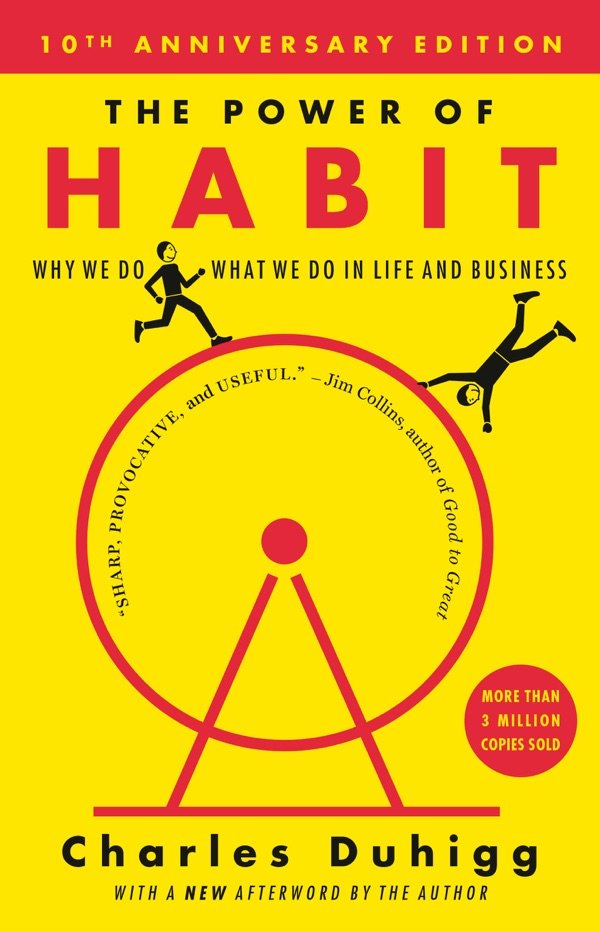
The Power of Habit: Why We Do What We Do in Life and Business
von Charles Duhigg
This is how new habits are created: by putting together a cue, a routine, and a reward, and then cultivating a craving that drives the loop.2.26 Take, for instance, smoking. When a smoker sees a cue—say, a pack of Marlboros—her brain starts anticipating a hit of nicotine. Just the sight of cigarettes is enough for the brain to crave a nicotine rush. If it doesn’t arrive, the craving grows until the smoker reaches, unthinkingly, for a Marlboro. Transforming his church into a movement, however—scaling it across twenty thousand parishioners and thousands of other pastors—required something more, something that made it self-perpetuating. Warren needed to teach people habits that caused them to live faithfully not because of their ties, but because it’s who they are. This is the third aspect of how social habits drive movements: For an idea to grow beyond a community, it must become self-propelling. And the surest way to achieve that is to give people new habits that help them figure out where to go on their own.
Habits are powerful, but delicate. They can emerge outside our consciousness, or can be deliberately designed. They often occur without our permission, but can be reshaped by fiddling with their parts. They shape our lives far more than we realize—they are so strong, in fact, that they cause our brains to cling to them at the exclusion of all else, including common sense.
If you believe you can change—if you make it a habit—the change becomes real. This is the real power of habit: the insight that your habits are what you choose them to be. Once that choice occurs—and becomes automatic—it’s not only real, it starts to seem inevitable, the thing, as James wrote, that bears “us irresistibly toward our destiny, whatever the latter may be.”
However, to modify a habit, you must decide to change it. You must consciously accept the hard work of identifying the cues and rewards that drive the habits’ routines, and find alternatives. You must know you have control and be self-conscious enough to use it—and every chapter in this book is devoted to illustrating a different aspect of why that control is real.
A movement starts because of the social habits of friendship and the strong ties between close acquaintances. It grows because of the habits of a community, and the weak ties that hold neighborhoods and clans together. And it endures because a movement’s leaders give participants new habits that create a fresh sense of identity and a feeling of ownership.
But the patients who didn’t write out any plans were at a significant disadvantage, because they never thought ahead about how to deal with painful inflection points. They never deliberately designed willpower habits. Even if they intended to walk around the block, their resolve abandoned them when they confronted the agony of the first few steps.
"This is how new habits are created: by putting together a cue, a routine, and a reward, and then cultivating a craving that drives the loop.2.26 Take, for instance, smoking. When a smoker sees a cue—say, a pack of Marlboros—her brain starts anticipating a hit of nicotine. Just the sight of cigarettes is enough for the brain to crave a nicotine rush. If it doesn’t arrive, the craving grows until the smoker reaches, unthinkingly, for a Marlboro."
"Transforming his church into a movement, however—scaling it across twenty thousand parishioners and thousands of other pastors—required something more, something that made it self-perpetuating. Warren needed to teach people habits that caused them to live faithfully not because of their ties, but because it’s who they are. This is the third aspect of how social habits drive movements: For an idea to grow beyond a community, it must become self-propelling. And the surest way to achieve that is to give people new habits that help them figure out where to go on their own."
"Anyone can use this basic formula to create habits of her or his own. Want to exercise more? Choose a cue, such as going to the gym as soon as you wake up, and a reward, such as a smoothie after each workout. Then think about that smoothie, or about the endorphin rush you’ll feel. Allow yourself to anticipate the reward. Eventually, that craving will make it easier to push through the gym doors every day."
"Habits are powerful, but delicate. They can emerge outside our consciousness, or can be deliberately designed. They often occur without our permission, but can be reshaped by fiddling with their parts. They shape our lives far more than we realize—they are so strong, in fact, that they cause our brains to cling to them at the exclusion of all else, including common sense."
"If you believe you can change—if you make it a habit—the change becomes real. This is the real power of habit: the insight that your habits are what you choose them to be. Once that choice occurs—and becomes automatic—it’s not only real, it starts to seem inevitable, the thing, as James wrote, that bears “us irresistibly toward our destiny, whatever the latter may be.”"
"However, to modify a habit, you must decide to change it. You must consciously accept the hard work of identifying the cues and rewards that drive the habits’ routines, and find alternatives. You must know you have control and be self-conscious enough to use it—and every chapter in this book is devoted to illustrating a different aspect of why that control is real."
"A movement starts because of the social habits of friendship and the strong ties between close acquaintances. It grows because of the habits of a community, and the weak ties that hold neighborhoods and clans together. And it endures because a movement’s leaders give participants new habits that create a fresh sense of identity and a feeling of ownership."
- →But the patients who didn’t write out any plans were at a significant disadvantage, because they never thought ahead about how to deal with painful inflection points. They never deliberately designed willpower habits. Even if they intended to walk around the block, their resolve abandoned them when they confronted the agony of the first few steps.
- →“When people are asked to do something that takes self-control, if they think they are doing it for personal reasons—if they feel like it’s a choice or something they enjoy because it helps someone else—it’s much less taxing. If they feel like they have no autonomy, if they’re just following orders, their willpower muscles get tired much faster.
- →But we do know that for habits to permanently change, people must believe that change is feasible. The same process that makes AA so effective—the power of a group to teach individuals how to believe—happens whenever people come together to help one another change. Belief is easier when it occurs within a community.
- →A company with dysfunctional habits can’t turn around simply because a leader orders it. Rather, wise executives seek out moments of crisis—or create the perception of crisis—and cultivate the sense that something must change, until everyone is finally ready to overhaul the patterns they live with each day.
Ähnliche Bücher gesucht?
Beschreibe deine Situation. Die Suche findet das passende Buch aus der gesamten Bibliothek.