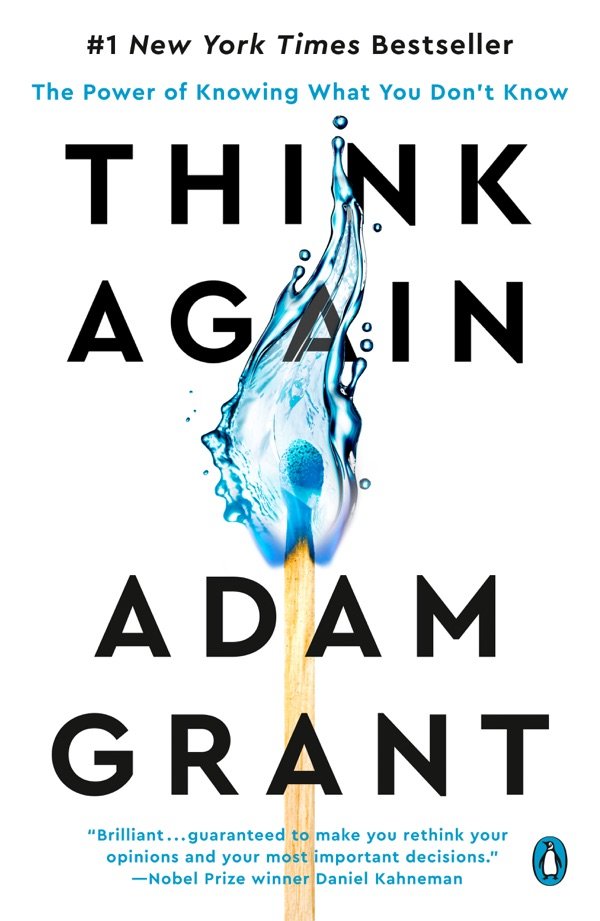
Think Again: The Power of Knowing What You Don't Know
von Adam M. Grant
Two decades ago my colleague Phil Tetlock discovered something peculiar. As we think and talk, we often slip into the mindsets of three different professions: preachers, prosecutors, and politicians. In each of these modes, we take on a particular identity and use a distinct set of tools. We go into preacher mode when our sacred beliefs are in jeopardy: we deliver sermons to protect and promote our ideals. We enter prosecutor mode when we recognize flaws in other people’s reasoning: we marshal arguments to prove them wrong and win our case. We shift into politician mode when we’re seeking to win over an audience: we campaign and lobby for the approval of our constituents. The risk is that we become so wrapped up in preaching that we’re right, prosecuting others who are wrong, and politicking for support that we don’t bother to rethink our own views. Active learning has impact far beyond physics. A meta-analysis compared the effects of lecturing and active learning on students’ mastery of the material, cumulating 225 studies with over 46,000 undergraduates in science, technology, engineering, and math (STEM). Active-learning methods included group problem solving, worksheets, and tutorials. On average, students scored half a letter grade worse under traditional lecturing than through active learning—and students were 1.55 times more likely to fail in classes with traditional lecturing. The researchers estimate that if the students who failed in lecture courses had participated in active learning, more than $3.5 million in tuition could have been saved.
In theory, confidence and competence go hand in hand. In practice, they often diverge. You can see it when people rate their own leadership skills and are also evaluated by their colleagues, supervisors, or subordinates. In a meta-analysis of ninety-five studies involving over a hundred thousand people, women typically underestimated their leadership skills, while men overestimated their skills.
many teachers don’t do enough to encourage students to question themselves and one another. To figure out what it takes to change that mindset, I tracked down some extraordinary educators who foster rethinking cycles by instilling intellectual humility, disseminating doubt, and cultivating curiosity. I also tested a few of my own ideas by turning my classroom into something of a living lab.
In 2004, a small group of engineers, designers, and marketers pitched Jobs on turning their hit product, the iPod, into a phone. “Why the f@*& would we want to do that?” Jobs snapped. “That is the dumbest idea I’ve ever heard.” The team had recognized that mobile phones were starting to feature the ability to play music, but Jobs was worried about cannibalizing Apple’s thriving iPod
I can’t think of a more vital time for rethinking. As the coronavirus pandemic unfolded, many leaders around the world were slow to rethink their assumptions—first that the virus wouldn’t affect their countries, next that it would be no deadlier than the flu, and then that it could only be transmitted by people with visible symptoms. The cost in human life is still being tallied.
Rethinking is more likely to happen in a learning culture, where growth is the core value and rethinking cycles are routine. In learning cultures, the norm is for people to know what they don’t know, doubt their existing practices, and stay curious about new routines to try out. Evidence shows that in learning cultures, organizations innovate more and make fewer mistakes.
"Two decades ago my colleague Phil Tetlock discovered something peculiar. As we think and talk, we often slip into the mindsets of three different professions: preachers, prosecutors, and politicians. In each of these modes, we take on a particular identity and use a distinct set of tools. We go into preacher mode when our sacred beliefs are in jeopardy: we deliver sermons to protect and promote our ideals. We enter prosecutor mode when we recognize flaws in other people’s reasoning: we marshal arguments to prove them wrong and win our case. We shift into politician mode when we’re seeking to win over an audience: we campaign and lobby for the approval of our constituents. The risk is that we become so wrapped up in preaching that we’re right, prosecuting others who are wrong, and politicking for support that we don’t bother to rethink our own views."
"Active learning has impact far beyond physics. A meta-analysis compared the effects of lecturing and active learning on students’ mastery of the material, cumulating 225 studies with over 46,000 undergraduates in science, technology, engineering, and math (STEM). Active-learning methods included group problem solving, worksheets, and tutorials. On average, students scored half a letter grade worse under traditional lecturing than through active learning—and students were 1.55 times more likely to fail in classes with traditional lecturing. The researchers estimate that if the students who failed in lecture courses had participated in active learning, more than $3.5 million in tuition could have been saved."
"We’d finally made some progress. Our next step was to examine the key ingredients behind the shift in fans’ views. We found that it was thinking about the arbitrariness of their animosity—not the positive qualities of their rival—that mattered. Regardless of whether they generated reasons to like their rivals, fans showed less hostility when they reflected on how silly the rivalry was. Knowing what it felt like to be disliked for ridiculous reasons helped them see that this conflict had real implications, that hatred for opposing fans isn’t all fun and games."
"We move into scientist mode when we’re searching for the truth: we run experiments to test hypotheses and discover knowledge. Scientific tools aren’t reserved for people with white coats and beakers, and using them doesn’t require toiling away for years with a microscope and a petri dish. Hypotheses have as much of a place in our lives as they do in the lab. Experiments can inform our daily decisions. That makes me wonder: is it possible to train people in other fields to think more like scientists, and if so, do they end up making smarter choices?"
"Say you have a friend who mentions a desire to stop smoking. You might respond by asking why she’s considering quitting. If she says a doctor recommended it, you might follow up by inquiring about her own motivations: what does she think of the idea? If she offers a reason why she’s determined to stop, you might ask what her first step toward quitting could be. “Change talk is a golden thread,” clinical psychologist Theresa Moyers says. “What you need to do is you need to pick that thread up and pull it.” So that’s what I did with Jeff."
"I’ve watched too many leaders shield themselves from task conflict. As they gain power, they tune out boat-rockers and listen to bootlickers. They become politicians, surrounding themselves with agreeable yes-men and becoming more susceptible to seduction by sycophants. Research reveals that when their firms perform poorly, CEOs who indulge flattery and conformity become overconfident. They stick to their existing strategic plans instead of changing course—which sets them on a collision course with failure."
"A fascinating example is the divide around emotional intelligence. On one extreme is Daniel Goleman, who popularized the concept. He preaches that emotional intelligence matters more for performance than cognitive ability (IQ) and accounts for “nearly 90 percent” of success in leadership jobs. At the other extreme is Jordan Peterson, writing that “There is NO SUCH THING AS EQ” and prosecuting emotional intelligence as “a fraudulent concept, a fad, a convenient band-wagon, a corporate marketing scheme.”"
- →Eventually John talked Brad out of it, and the goo was gone. “I love working with John, because he’ll give me the bad news straight to my face,” Brad says. “It’s good that we disagree. It’s good that we fight it out. It makes the stuff stronger.” Those fights have helped Brad win two Oscars—and made him a better learner and a better leader.
- →Yet it hadn’t learned to agree with elements of the other side’s argument, apparently because that behavior was all too rarely deployed across 400 million articles by humans. They were usually too busy preaching their arguments, prosecuting their enemies, or politicking for audience support to grant a valid point from the other side.
- →In science, a challenge network is often a cornerstone of the peer-review process. We submit articles anonymously, and they’re reviewed blindly by independent experts. I’ll never forget the rejection letter I once received in which one of the reviewers encouraged me to go back and read the work of Adam Grant. Dude, I am Adam Grant.
- →On Seinfeld, George Costanza famously said, “It’s not a lie if you believe it.” I might add that it doesn’t become the truth just because you believe it. It’s a sign of wisdom to avoid believing every thought that enters your mind. It’s a mark of emotional intelligence to avoid internalizing every feeling that enters your heart.
Ähnliche Bücher gesucht?
Beschreibe deine Situation. Die Suche findet das passende Buch aus der gesamten Bibliothek.