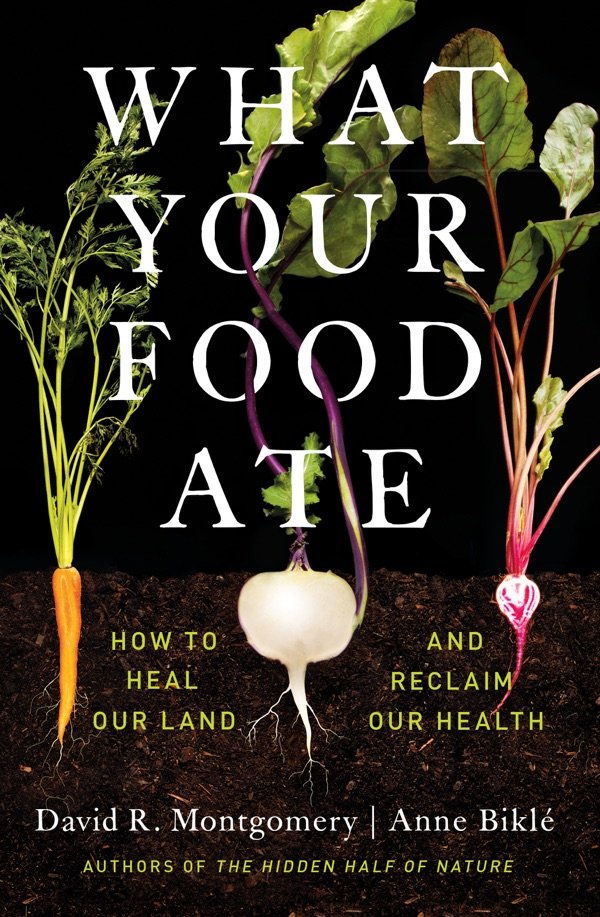
What Your Food Ate: How to Heal Our Land and Reclaim Our Health
von David R. Montgomery
Yet no matter what you may think about industrial agriculture, we cannot simply pin poor soil health on modern farming. After all, Rome’s farmers managed to devastate the soils of central Italy, Syria, and Libya long before agrochemicals existed. By plowing too much and too often. While they used manure to boost harvests, persistent tillage eroded the fertility of their land right out from under them over the long run. Globally, micronutrient malnutrition is now more common than inadequate calories. Iron deficiency afflicts an estimated two billion people. Zinc deficiency affects at least a fifth of humanity and is particularly high in sub-Saharan Africa and South Asia. Almost a third of the U.S. population is deficient in at least one vitamin, and almost a quarter lacks sufficient iron.
Globally, micronutrient malnutrition is now more common than inadequate calories. Iron deficiency afflicts an estimated two billion people. Zinc deficiency affects at least a fifth of humanity and is particularly high in sub-Saharan Africa and South Asia. Almost a third of the U.S. population is deficient in at least one vitamin, and almost a quarter lacks sufficient iron.
When the rate at which carbon is released from soil organic matter races ahead of the ability of soil life to reincorporate it into more biomass, the excess carbon doesn’t just disappear. It heads skyward. A late 1970s study found a third of the carbon added to the atmosphere since the industrial revolution came from degrading organic matter in agricultural soils.
While the percentage of income spent on food fell by half since the 1950s, the societal cost of health care more than doubled. Our century-long experiment with conventional agriculture seems to have left us better fed than ever in terms of calories consumed but reeling from a slew of chronic diseases. Maybe cheap food isn’t so cheap after all.
When plants first came ashore more than 400 million years ago, their roots served mostly as an anchor while fungi provided them with minerals from the soil. How do we know? Early fossil land plants have mycorrhizal fungi entwined with their primitive roots.
Just what is soil health? The U.S. Department of Agriculture (USDA) defines it as the continued capacity of soil to function as a vital living ecosystem that sustains plants, animals, and humans.
"Yet no matter what you may think about industrial agriculture, we cannot simply pin poor soil health on modern farming. After all, Rome’s farmers managed to devastate the soils of central Italy, Syria, and Libya long before agrochemicals existed. By plowing too much and too often. While they used manure to boost harvests, persistent tillage eroded the fertility of their land right out from under them over the long run."
"Globally, micronutrient malnutrition is now more common than inadequate calories. Iron deficiency afflicts an estimated two billion people. Zinc deficiency affects at least a fifth of humanity and is particularly high in sub-Saharan Africa and South Asia. Almost a third of the U.S. population is deficient in at least one vitamin, and almost a quarter lacks sufficient iron."
"When the rate at which carbon is released from soil organic matter races ahead of the ability of soil life to reincorporate it into more biomass, the excess carbon doesn’t just disappear. It heads skyward. A late 1970s study found a third of the carbon added to the atmosphere since the industrial revolution came from degrading organic matter in agricultural soils."
"While the percentage of income spent on food fell by half since the 1950s, the societal cost of health care more than doubled. Our century-long experiment with conventional agriculture seems to have left us better fed than ever in terms of calories consumed but reeling from a slew of chronic diseases. Maybe cheap food isn’t so cheap after all."
"When plants first came ashore more than 400 million years ago, their roots served mostly as an anchor while fungi provided them with minerals from the soil. How do we know? Early fossil land plants have mycorrhizal fungi entwined with their primitive roots."
"Just what is soil health? The U.S. Department of Agriculture (USDA) defines it as the continued capacity of soil to function as a vital living ecosystem that sustains plants, animals, and humans."
"About a third of the world’s agricultural land suffers from serious topsoil erosion or reduced fertility that compromises the well-being of at least 3.2 billion people."
- →When plants first came ashore more than 400 million years ago, their roots served mostly as an anchor while fungi provided them with minerals from the soil. How do we know? Early fossil land plants have mycorrhizal fungi entwined with their primitive roots.
- →Regenerative farming practices can help stop soil erosion, enhance soil health, and build up soil organic matter (soil carbon).
Ähnliche Bücher gesucht?
Beschreibe deine Situation. Die Suche findet das passende Buch aus der gesamten Bibliothek.