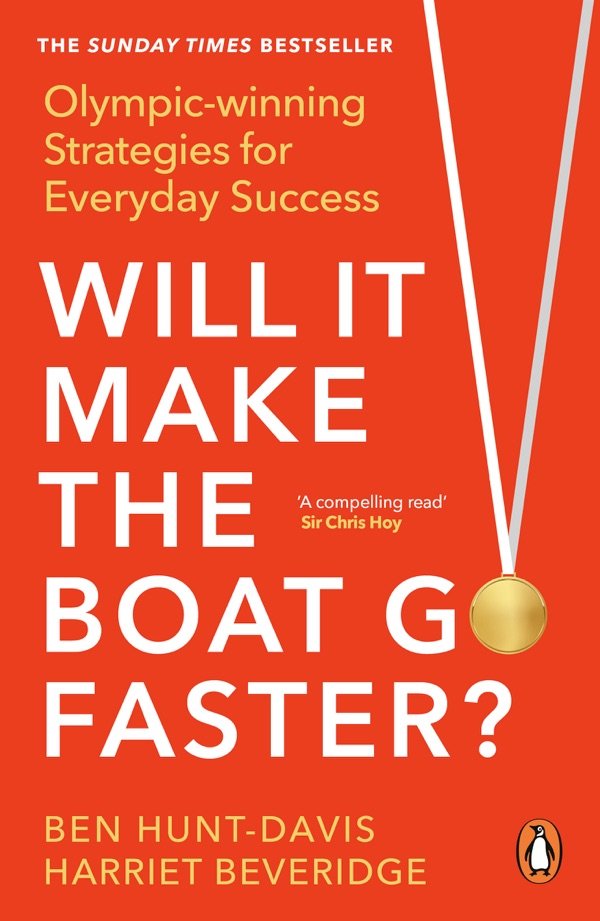
Will It Make the Boat Go Faster?: Olympic-Winning Strategies for Everyday Success
von Harriet Beveridge
Instead of laughing away our negative thoughts or other people’s unhelpful comments and moving on, sometimes, we let them stick and start to accept them as unarguable truths. We might sort through our bedroom cupboards and think, “Why on earth have I kept that pair of purple socks all these years?”, yet we rarely do that with the unhelpful thoughts clogging our heads. Ben and the crew worked hard to develop bullshit filters – ways of getting rid of the negative thoughts and feelings that would get in the way of reaching Gold. Why was this so important? Why not just stick to building useful beliefs as described in the beliefs chapter? The problem was that we’d also left our bullshit filters off. We’d fooled ourselves into thinking that winning the Regatta was important when that was bullshit. What we really wanted was to win the Olympics and if we wanted that we needed to perform well. We needed to row our race, our rhythm. At the time I didn’t think that Martin went about it in the right way, but, looking back on it now, he was exactly right; his job was not to be nice to us and be our friend it was to make us faster than anyone else in the world.
The ten minute rule is a tried and tested time management technique. If we set ourselves a goal of doing something for just ten minutes we’ll probably end up getting further than if we set ourselves a meaty target. For example, say we wanted to learn a language our goal might be to learn vocab for ten minutes today…but then we’d allow ourselves to stop if we wanted.
Ben: “Get over it! I had a saying when I was first in the team along the lines of: ‘there is no point in worrying about it, because if you are worrying about it then you will do something about it and if you are doing something about it then there is no need to worry. If you are not working on it then clearly you aren’t that worried about it!!’”
Ben: “There were sessions where we’d come in off the water and it had been so cold that there was ice on the boat, the oars and even our kit and people asked me why on earth was I doing this? It was because I believed that we could win the Gold, I believed in the guys I was with, I believed in the coach – I believed that it was all worthwhile.”
How can you remind yourself of your beliefs? Examples from our clients include: •Making it a standard agenda item at team meetings. •Keeping personal journals to write down and revisit reasons. •Putting visual reminders out – e.g. one client put a (small!) rock on his desk to remind himself of the rock-solid reasons why he would succeed.
With that in mind, focus on your goal and write down five reasons why it’s totally reasonable that you should achieve it. You don’t need to be arrogant, quite the reverse – it’s just a book, or a promotion, or a deal. The opportunity is there for everyone else, you’ve worked hard for it – there, that’s two to start your list already!
"Instead of laughing away our negative thoughts or other people’s unhelpful comments and moving on, sometimes, we let them stick and start to accept them as unarguable truths. We might sort through our bedroom cupboards and think, “Why on earth have I kept that pair of purple socks all these years?”, yet we rarely do that with the unhelpful thoughts clogging our heads. Ben and the crew worked hard to develop bullshit filters – ways of getting rid of the negative thoughts and feelings that would get in the way of reaching Gold. Why was this so important? Why not just stick to building useful beliefs as described in the beliefs chapter?"
"The problem was that we’d also left our bullshit filters off. We’d fooled ourselves into thinking that winning the Regatta was important when that was bullshit. What we really wanted was to win the Olympics and if we wanted that we needed to perform well. We needed to row our race, our rhythm. At the time I didn’t think that Martin went about it in the right way, but, looking back on it now, he was exactly right; his job was not to be nice to us and be our friend it was to make us faster than anyone else in the world."
"We tend to assume change is a bad thing, but change can make our boat go dramatically faster. We also worry that change is difficult, but the crew’s experience shows that there are some very simple ways to make change easier and even enjoyable. Some of it is to do with mindset – putting ourselves in the driving seat, not being a victim. Some of it is to do with communication – building bridges and looking for the upsides- and the final bit of the jigsaw is taking simple actions to put the change into practice."
"•What gets you one result rather than another? •What are the variables that might be having an impact? Most people are oblivious to the causes that get them their results. Simply by waking up and wondering, you are one step ahead of the competition. For example, I’m not going to appear on Masterchef anytime soon – in fact my son commented the other day, “Daddy cooks stuff and puts it in the fridge and then Mummy puts it in the microwave until it goes ping.”"
"Ben: “When Fred joined the group he brought with him a few Oxford Brookes sayings including ‘don’t talk bollocks to Basil’. I have absolutely no idea who coined the phrase or who the original Basil was, but what it meant was don’t share stuff with people you shouldn’t be talking to. Focus on people who are of interest to you, people who matter. Focus on who or what will make the boat go faster. Anything else is simply talking bollocks to Basil.”"
"If you are too comfortable then it can be difficult to motivate yourself to change. For those of you old enough to remember life before remote controls, did you ever sit and watch a rubbish TV programme because you couldn’t be bothered to get off the sofa and change channels? Only when something truly dreadful came on were you motivated to change. The pain of the status quo can be as motivating as the promise of achieving your goal."
"Ben: “It was very easy to get distracted. For example, Harry was passionate and would get wrapped up in the moment. He’d go off on a tangent in the middle of a training session. Martin would warn us in advance to keep focused on the pre-agreed training goals for that day. You get what you focus on. You don’t have to work harder; it’s not through doing more hours, it is by being more focused within those hours.”"
- →Ben: “Get over it! I had a saying when I was first in the team along the lines of: ‘there is no point in worrying about it, because if you are worrying about it then you will do something about it and if you are doing something about it then there is no need to worry. If you are not working on it then clearly you aren’t that worried about it!!’”
- →Ben: “There were sessions where we’d come in off the water and it had been so cold that there was ice on the boat, the oars and even our kit and people asked me why on earth was I doing this? It was because I believed that we could win the Gold, I believed in the guys I was with, I believed in the coach – I believed that it was all worthwhile.”
- →How can you remind yourself of your beliefs? Examples from our clients include: •Making it a standard agenda item at team meetings. •Keeping personal journals to write down and revisit reasons. •Putting visual reminders out – e.g. one client put a (small!) rock on his desk to remind himself of the rock-solid reasons why he would succeed.
- →With that in mind, focus on your goal and write down five reasons why it’s totally reasonable that you should achieve it. You don’t need to be arrogant, quite the reverse – it’s just a book, or a promotion, or a deal. The opportunity is there for everyone else, you’ve worked hard for it – there, that’s two to start your list already!
Ähnliche Bücher gesucht?
Beschreibe deine Situation. Die Suche findet das passende Buch aus der gesamten Bibliothek.